
Biodegradable Shrink Wrap: The Future of Site Containment?
- Lee James

- Dec 5, 2025
- 4 min read
Updated: Jul 13
Understanding Biodegradable Materials
'Biodegradable' is a term that has gained significant traction, appearing in various products from food packaging to carrier bags. It suggests an easy sustainability win: use a biodegradable product, and it will naturally decompose at the end of its life cycle.
The construction industry is now engaging in discussions about biodegradable shrink wrap for site containment. But are these wraps genuinely the future of temporary protection, or are they merely another green marketing tactic?
This article delves into what biodegradable truly means in practice, how disposal methods influence outcomes, and why biodegradable shrink wrap presents a clearer, more effective approach to reducing long-term plastic pollution on active construction sites.
What Does 'Biodegradable' Actually Mean?
Biodegradable is not a single standard; it is an umbrella term. In simple terms, it refers to materials that can be broken down by microorganisms into natural components over time. However, the performance of biodegradable materials depends on several factors:
Environmental conditions (moisture, oxygen, temperature)
Material formulation
Timescale
Exposure to microbes
Unlike conventional LDPE, biodegradable shrink wrap is designed with 'end of life' in mind from the outset. This distinction is crucial on construction sites. Traditional plastics can persist for decades if lost or landfilled, while biodegradable materials are engineered to degrade naturally. This reduces their long-term environmental impact, even when recovery efforts fail.
Why End of Life Reality Matters on Construction Sites
Construction sites are high-loss environments. Shrink wrap is often exposed to:
Wind
Debris
Contamination
Programme changes
Mixed waste handling
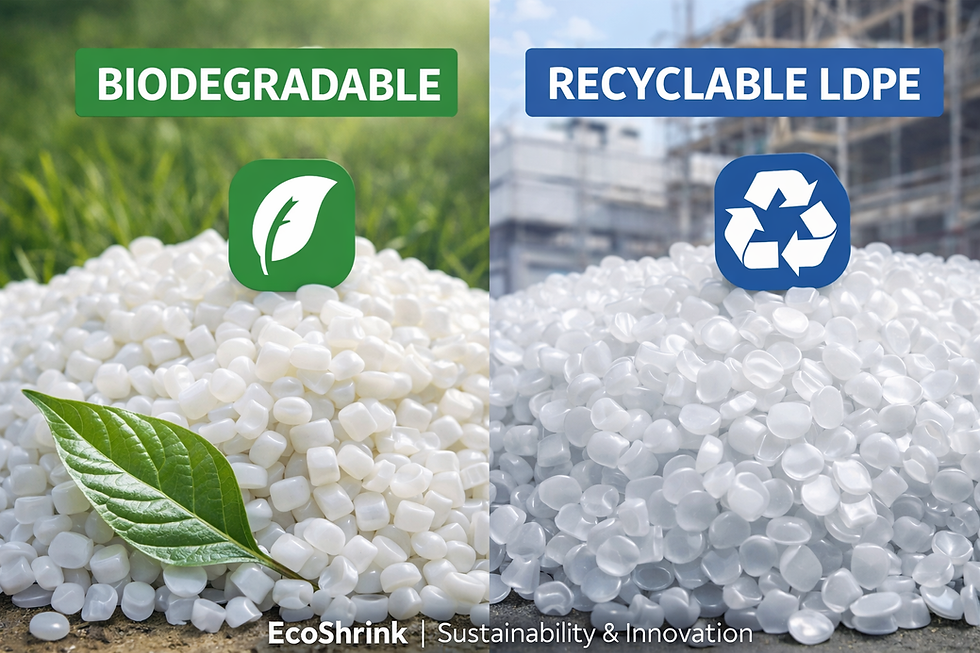
Even with good intentions, not all wrap is cleanly segregated or recovered. This is where biodegradation earns its place. Recycling is still the primary disposal route where local infrastructure accepts film waste, and BIOSHRINK is a fully recyclable LDPE film. But where recovery isn't possible, biodegradation acts as a built-in environmental safety net, so material that escapes collection doesn't remain as permanent plastic waste.
Key Benefits of Biodegradable Site Containment
🌱 Reduces Long-Term Plastic Pollution
Biodegradable wrap breaks down naturally instead of persisting in landfill or soil. This significantly lessens the burden of plastic waste on the environment.
🌱 End-of-Life Safety Net When Recycling Fails
Segregation and clean film still matter, but biodegradation reduces long-term plastic persistence if material is lost or contaminated.
🌱 Better Aligned with Future Regulation
As scrutiny on single-use plastics increases, biodegradable solutions are far better positioned to meet evolving sustainability expectations. They align with the growing demand for environmentally responsible materials.
🌱 Simplifies Procurement Conversations
Clients increasingly seek materials that reduce risk, not solutions that depend on ideal waste routing. For temporary protection, biodegradable shrink wrap presents a more resilient sustainability strategy.
Why Combining Biodegradation and Recyclability Matters
Recycling and biodegradation are often presented as alternatives. In practice, the best outcome combines both. Recyclable LDPE shrink wrap can reduce virgin plastic use when:
The film is kept clean
Segregation works properly
Local recycling infrastructure exists
But on construction sites, recovery is often imperfect. Issues include:
Wrap becomes contaminated
Film enters mixed skips
Recycling routes vary by region
Where recovery succeeds, recycling is the right outcome, energy-efficient, lower environmental impact, established infrastructure. Where recovery fails, conventional LDPE persists for decades. BIOSHRINK is designed to address both sides: it's built on a fully recyclable LDPE base, meaning the primary disposal route is responsible recycling where local infrastructure accepts film waste, but it also biodegrades under documented test conditions, providing an end-of-life safety net if material is lost, contaminated or routed to landfill. Recycling manages plastic when recovery succeeds. Biodegradation reduces harm when it doesn't. BIOSHRINK delivers both routes from the same product.
Are Biodegradable Shrink Wraps Ready for Construction?
Modern biodegradable shrink wraps are now capable of meeting the same core requirements as conventional site containment materials:
Weather resistance
Mechanical strength
Installation performance
Appearance and wind behaviour
Provided they meet relevant fire and performance standards, biodegradable wraps can be used for:
Scaffold encapsulation
Modular building protection
Temporary weatherproofing
Site containment
This makes BIOSHRINK a viable, future-facing route for many projects today.
A Practical Sustainability Pathway
For most contractors, a sensible approach looks like this:
Short Term
Specify BIOSHRINK as the temporary protection film, matching the right grade to the application, fire requirement and programme, combining a recyclable LDPE base with biodegradable end-of-life mitigation.
Medium Term
Document temporary protection consistently in procurement contracts and specifications, with end-of-use handling agreed up front rather than left to site.
Long Term
Build temporary protection specifications that consider both routes: recycling as the primary disposal, biodegradation as the end-of-life safety net, backed by an evidence pack and project-by-project review.
EcoShrink's BIOSHRINK range is built around this principle: biodegradable, fully recyclable, and engineered to perform on real construction sites.
Summary
Construction sites rarely achieve perfect plastic recovery.
Recyclable LDPE alone depends heavily on segregation and infrastructure to deliver its environmental benefit.
Biodegradation reduces long-term harm when recovery fails, but it doesn't replace recycling as the primary disposal route.
BIOSHRINK is engineered to deliver both: a recyclable LDPE base with documented biodegradation as end-of-life mitigation, more resilient than choosing one route alone.
As expectations rise, the question isn't "biodegradable or recyclable", it's "how do we ensure responsible end-of-life whether or not recovery succeeds?" BIOSHRINK answers that directly by delivering both routes from the same product.
Frequently Asked Questions
Does biodegradable shrink wrap break down in landfill or skips?
Biodegradable shrink wrap is designed to degrade naturally over time, reducing long-term plastic persistence even when routed through typical construction waste streams.
Can biodegradable shrink wrap be used for scaffold containment?
Yes. Modern biodegradable shrink wraps can be used for scaffold and modular protection, provided they meet project fire and performance requirements.
Does biodegradable wrap perform like standard LDPE?
Yes, biodegradable shrink wrap is engineered to deliver comparable strength, weather resistance, and installation performance.
Want to explore biodegradable site containment for your next project?
View our biodegradable shrink wrap solutions or contact EcoShrink to discuss BIOSHRINK options for scaffold, modular, and temporary protection.
It is already available. Buy BIOSHRINK FR300 — biodegradable scaffold shrink wrap — certified EN 13501-1 Class B-s1,d0, installs like standard film.
