
Country House Restoration, Reading – BIOSHRINK Temporary Scaffold Enclosure

Updated: Jul 13
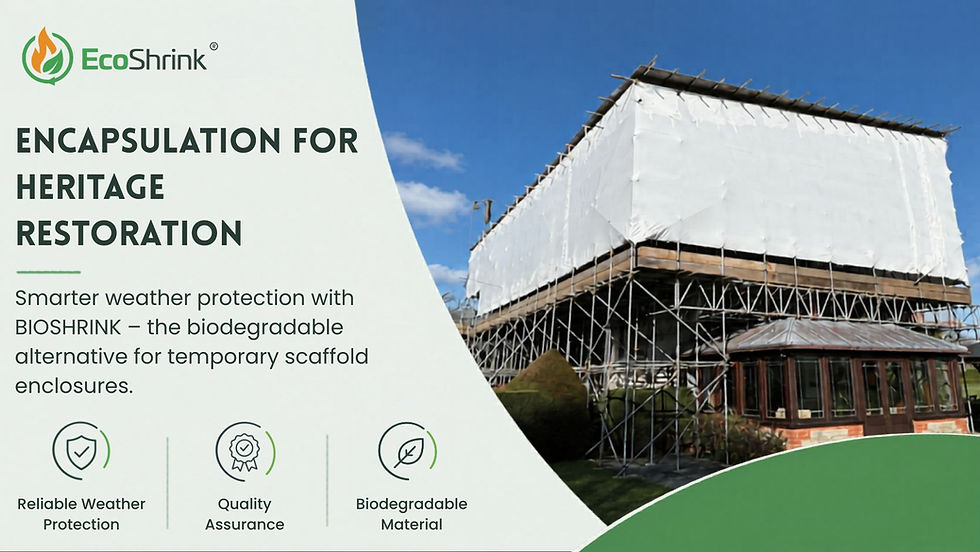
EcoShrink installed a BIOSHRINK temporary scaffold enclosure around a country house near Reading undergoing a full restoration. With the property set in extensive grounds and the works running over an extended programme, the scaffold needed long-term weather protection and a clean, controlled outer skin rather than loose sheeting.
The brief
The house sat exposed on open ground, visually prominent, and was undergoing a full external refurbishment, so the enclosure had to do more than cover the scaffold. It needed to protect the working areas from wind and driving rain for the length of the programme, present tidily on a high-value property that owners, architects and visitors would see regularly, and hold up over a long installation rather than a quick job.
What we did
EcoShrink specified and installed BIOSHRINK as the scaffold wrap, fixed and heat-welded into a tight, tensioned outer skin. The approach started with the scaffold layout rather than the film: fixing points, clear elevations, access routes, loading bays and roofline transitions. The film was installed in controlled sections to form a cleaner, more professional enclosure than conventional sheeting can normally achieve. Detailing focused on the finish a prominent property demands, with tidy returns and corners, controlled openings for access and material movement, and clean transitions around the roofline.
Why BIOSHRINK
BIOSHRINK is the construction-grade shrink wrap EcoShrink uses across every project. It is biodegradable and fully recyclable, and it is engineered to install and perform exactly like conventional shrink wrap. On a long-duration restoration that means the same tensioned, heat-welded weather protection contractors expect, with a more responsible end-of-life route built in. The primary route is recycling where UK film-recycling infrastructure accepts it, with biodegradation as a built-in safety net if recovery is not possible. BIOSHRINK still needs controlled removal and responsible disposal at the end of the works; it is not compostable, plastic-free or zero-waste.
Outcome
On a country house in open grounds, the site is judged partly on how it looks while the work is going on. A tensioned, heat-welded BIOSHRINK skin reads as a controlled, presentable enclosure rather than a patched or flapping covering, which matters where owners, architects and estate teams see the property throughout a long programme. A scaffold enclosure is not a permanent building envelope, and its performance depends on scaffold design, exposure, installation quality and inspection over the programme. Specified and installed correctly, it kept the restoration works protected and the property presenting cleanly for the duration.
Frequently asked questions
Can BIOSHRINK provide long-term weather protection on a restoration?
Yes, for the duration of the works when it is specified, installed and inspected correctly. A heat-welded BIOSHRINK enclosure is tensioned and fixed to the scaffold, so it holds up over an extended programme far better than loose sheeting. It is a temporary enclosure rather than a permanent building envelope, so performance still depends on scaffold design, exposure and inspection during the works.
Is BIOSHRINK suitable for an exposed country house setting?
Yes. On open or semi-rural ground with long elevations and complex rooflines, a tensioned, heat-welded skin handles wind and driving rain more reliably than loose sheeting and presents cleanly on a prominent property. Which elevations are fully wrapped and which are only screened is decided from the scaffold layout and exposure at the specification stage.
What happens to the BIOSHRINK film at the end of the project?
BIOSHRINK is biodegradable and fully recyclable. The primary route is responsible recycling where UK film-recycling infrastructure accepts it, with biodegradation built in as a safety net if recovery is not possible. It still needs controlled removal and responsible disposal, so it should not be described as zero-waste.
Planning a restoration project?
Planning a country house restoration, period property refurbishment or other high-value residential project? EcoShrink can assess the scaffold design, exposure, programme and end-of-use requirements, then install a BIOSHRINK enclosure to suit.
Contact the EcoShrink team to discuss your restoration.
Specify the same film on your project. Buy BIOSHRINK FR300 online — biodegradable, flame-retardant, 300 micron.

