
Moving Towards Greener Site Protection Without Compromising Performance
- EcoShrink

- Jan 30
- 8 min read
Updated: Jun 15
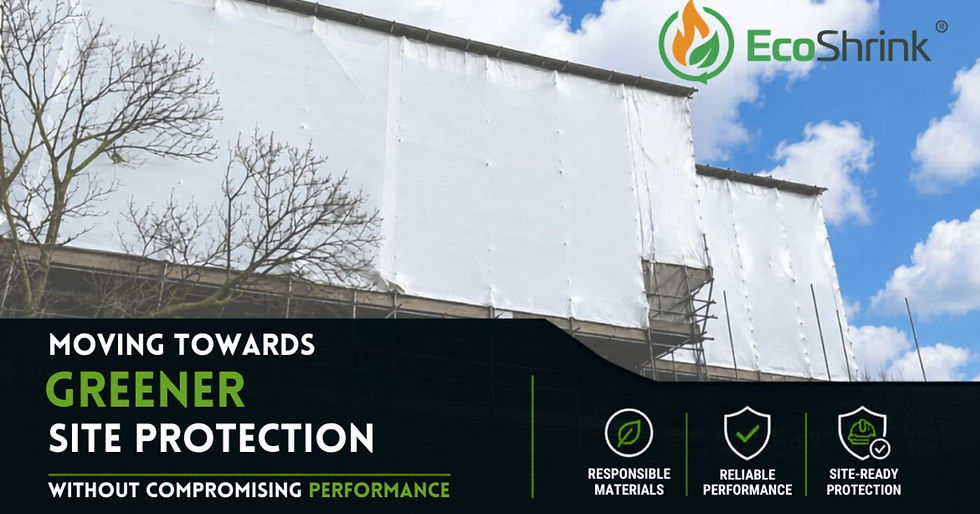
The next stage of site protection has to be practical
Temporary protection is rarely the headline item on a construction or refurbishment project, but it can have a major effect on how a site performs. Scaffold wraps, facade screens, containment enclosures, modular covers and weather protection systems help keep work areas cleaner, safer and more controlled. They can protect exposed works, reduce weather disruption, screen sensitive areas and improve the appearance of a live site.
At the same time, contractors are being asked to think more carefully about the materials they use. Project teams are under pressure to reduce waste, review supply chains, improve environmental reporting and avoid unnecessary single-use materials. That pressure now extends to temporary protection.
The challenge is that temporary protection still has a job to do. A greener product is not a good choice if it fails early, creates rework, damages the programme or has to be replaced halfway through the job. The future of site protection cannot be based on sustainability language alone. It has to combine better material choices with practical site performance.
Why sustainability cannot be separated from performance
In construction, sustainability and performance are often spoken about as if they are competing priorities. The reality is more connected. A product that performs badly can create waste of its own: wasted labour, replacement material, additional transport, delays, damaged work and extra management time.
Temporary protection is usually installed because there is a real risk to control. It may be weather exposure on a scaffolded building, dust migration during refurbishment, debris containment, public-facing presentation, modular transport protection or a need to create a more controlled working area. If the material does not suit the application, the project can lose the very benefit the protection was meant to provide.
That is why EcoShrink believes greener site protection has to start with the specification, not the marketing claim. The right question is not simply whether a product sounds sustainable. The better question is whether it is a responsible option for the specific application, exposure, duration, fire requirement, installation method and end-of-use route.
What contractors are starting to look for
Contractors and procurement teams are becoming more careful about the difference between a useful sustainability improvement and a vague environmental claim. On a live project, they need information that can be reviewed, explained and defended.
In practice, that means buyers are starting to ask sharper questions:
What is the material designed for: scaffold encapsulation, facade screening, containment, weather protection or transport cover?
What evidence supports the product claims?
Is the material suitable for the expected exposure and programme duration?
Does the product need a fire-retardant specification for this environment?
Who will install it, and are they competent to create a reliable enclosure?
How will the material be removed, handled and disposed of at the end of the project?
Will the final installation look professional enough for the client, public or neighbouring properties?
Where BIOSHRINK fits into the conversation
BIOSHRINK is EcoShrink's construction-grade shrink wrap for temporary protection. It is the film we now use across our work, engineered to perform on real sites while giving contractors a more responsible material from the outset, rather than a sustainability label bolted on afterwards.
BIOSHRINK is built on a fully recyclable LDPE base, with biodegradation added as an end-of-life safety net. That gives the same product both routes, recycle it first where local infrastructure accepts LDPE, and if recovery is not possible it biodegrades rather than persisting as permanent plastic. It keeps the end-of-life conversation honest rather than forcing a choice between recycling and biodegradation.
None of this means BIOSHRINK should be oversold. It does not remove the need for responsible removal and disposal. It does not make poor installation acceptable. Its role is more specific and more useful: it gives contractors a practical product conversation that combines greener site protection with the demands of a live construction environment.
Practicality starts with the application
Before the right grade and installation method are chosen, the application needs to be understood. A scaffold wrap around a period property is not the same as a short-term facade screen. A modular transport cover is not the same as an industrial containment enclosure. A low-level domestic refurbishment is not the same as an exposed city-centre scaffold.
Each application affects how BIOSHRINK should be specified and installed. Wind exposure, fixing points, scaffold design, access, heat-welding requirements, public interface, project duration and fire-retardant needs all influence the decision.
This is where EcoShrink's installation knowledge matters. A product can look straightforward on a data sheet but behave differently on site. Corners, returns, rooflines, lift heights, scaffold ties, temporary openings and awkward access points all affect how a protective screen performs. Greener site protection has to work in those real conditions.
The risk of weak sustainability claims
One of the biggest risks in this part of the market is greenwash. Terms such as biodegradable, compostable, recyclable, recycled-content, oxo-degradable and sustainable are often used loosely. They can sound similar but mean very different things.
For contractors, that creates a practical and reputational risk. A buyer may believe they are making a better environmental choice, but if the claim is unclear, unsupported or misunderstood, the project can be exposed to criticism.
EcoShrink's approach is to keep BIOSHRINK wording disciplined. Claims should be tied to the appropriate evidence, test conditions and product information. Where biodegradation is discussed, the conditions matter. Where end-of-use is discussed, responsible disposal still matters. Where performance is discussed, site suitability still matters.
That approach may be less flashy than broad green marketing, but it is more useful for contractors who need to make decisions responsibly.
Good installation is part of the sustainability outcome
A more responsible material is only one part of the system. Installation quality has a direct effect on how long temporary protection lasts and how well it performs.
Poorly installed shrink wrap or scaffold sheeting can flap, tear, open at seams, look untidy or require repeated repair. That creates more labour, more waste and more disruption. A well-planned installation, by contrast, can help the material do its job for the intended period, reduce avoidable replacement and support a cleaner site presentation.
This is why EcoShrink connects product innovation with installation and training. Greener site protection is not just a roll of film. It is the combination of correct specification, competent installation, suitable fixing, good heat-welding practice, careful removal and clear guidance.
How greener site protection supports project teams
When specified correctly, greener temporary protection can support more than an environmental message. It can help project teams show that they are considering material impact at a practical level, including areas of the job that are often overlooked.
For refurbishment contractors, this can support client conversations around responsible works. For scaffolders, it can create a stronger offer when clients ask about more sustainable site screening. For modular contractors, it can help demonstrate that protection during storage and transport is being considered. For principal contractors, it can support procurement narratives without relying on unrealistic claims.
The value is not simply in saying a product is greener. The value is in being able to show why the material was chosen, what it was used for, how it performed and how the end-of-use process was considered.
Why EcoShrink moved fully to BIOSHRINK
Conventional shrink wrap is still widely used across the industry, and for good reason, it has been the workhorse of temporary protection for decades. But at EcoShrink we made a deliberate call: rather than offer both as parallel options, we moved fully to BIOSHRINK as our standard wrap.
The reasoning is straightforward. BIOSHRINK performs the same on site as conventional shrink wrap, same tensioning, same heat-welded seams, same fixing, same finish, so the end-of-life advantage of biodegradation comes without asking the project to compromise on site protection. There is no practical reason to keep specifying a less responsible film when the performance is equivalent.
This is why the "greener vs practical" trade-off matters less than it sounds. With BIOSHRINK, contractors do not have to pick a side. They get the protection conventional shrink wrap has always delivered, and a more responsible end-of-life route in the same product.
A better way to specify temporary protection
A stronger specification conversation should include both performance and sustainability. Rather than asking for "shrink wrap" or "sheeting" in broad terms, project teams can define what the temporary protection needs to achieve.
What is being protected or contained?
How long does the protection need to remain in place?
How exposed is the site?
Is the appearance important for neighbours, clients or the public?
Is a fire-retardant grade required?
Is the priority weather protection, containment, screening, transport protection or presentation?
What product information, sample or evidence pack does procurement need?
The EcoShrink approach: Install, Supply and Train
EcoShrink's approach to greener site protection sits within the wider Install, Supply and Train strategy.
Install keeps EcoShrink close to real project conditions. It means product decisions are informed by what happens on scaffold, around buildings, in containment zones and during modular protection work.
Supply allows EcoShrink to provide BIOSHRINK with clearer product guidance, sample support and specification conversations.
Train, through Shrink Wrap Academy by EcoShrink, supports competence across the industry so that material performance is not undermined by poor installation practice.
That combination matters because the future of temporary protection will not be solved by materials alone. It will be improved by better products, better installation and better understanding.
Moving forward without pretending the problem is solved
Construction does not become sustainable by changing one product. Temporary protection still creates material use. It still needs responsible removal. It still needs clear waste handling. It still needs honest claims and proper specification.
But progress does not require perfection. It requires practical steps that can be used, tested, documented and improved. BIOSHRINK is one of those steps, and it is the wrap EcoShrink now uses across our work.
For contractors, the opportunity is to move away from basic product selection and towards more considered temporary protection decisions. That means choosing materials that are fit for purpose, explaining sustainability claims properly, installing systems competently and thinking about end-of-use from the beginning.
Greener site protection should not mean weaker site protection. It should mean better decisions, better evidence and a more responsible material as standard, without compromising performance.
Next step for contractors and procurement teams
If you are planning scaffold encapsulation, facade screening, containment, modular covers or temporary weather protection, EcoShrink can review the application and match the right BIOSHRINK grade and installation approach, along with the product evidence procurement needs.
The aim is not to make a generic recommendation. The aim is to help you choose a practical, evidence-led specification that supports both site performance and a more responsible material conversation.
Frequently asked questions
Does greener site protection mean weaker site protection?
No. Greener site protection should still be specified around practical site performance. The material needs to suit the application, exposure, duration, installation method and end-of-use route. BIOSHRINK is engineered to perform the same on site as conventional shrink wrap, so moving to a more responsible material does not mean accepting a weaker result.
Why does installation quality matter for sustainability?
Poor installation can lead to early failure, repairs, replacement material and extra labour, which adds waste and undermines the environmental benefit of any material choice. Competent installation helps the protection perform for the intended period and reduces avoidable replacement, which is part of what makes a greener specification actually greener in practice.
What questions should procurement ask about sustainability claims?
Procurement should ask what the claim specifically refers to (biodegradation, recyclability, recycled content, low carbon, these are not the same thing), what evidence and test conditions support it, what disposal route the product is designed for, and whether the product still meets the project's performance, fire and installation requirements. Claims that cannot be tied back to evidence, test conditions or a defined end-of-use route should be treated with caution.
Considering greener temporary protection for an upcoming project? Speak to EcoShrink about scaffold encapsulation, facade screening, containment, modular covers or temporary weather protection. We will review the application and provide suitable product information, samples and specification support.
